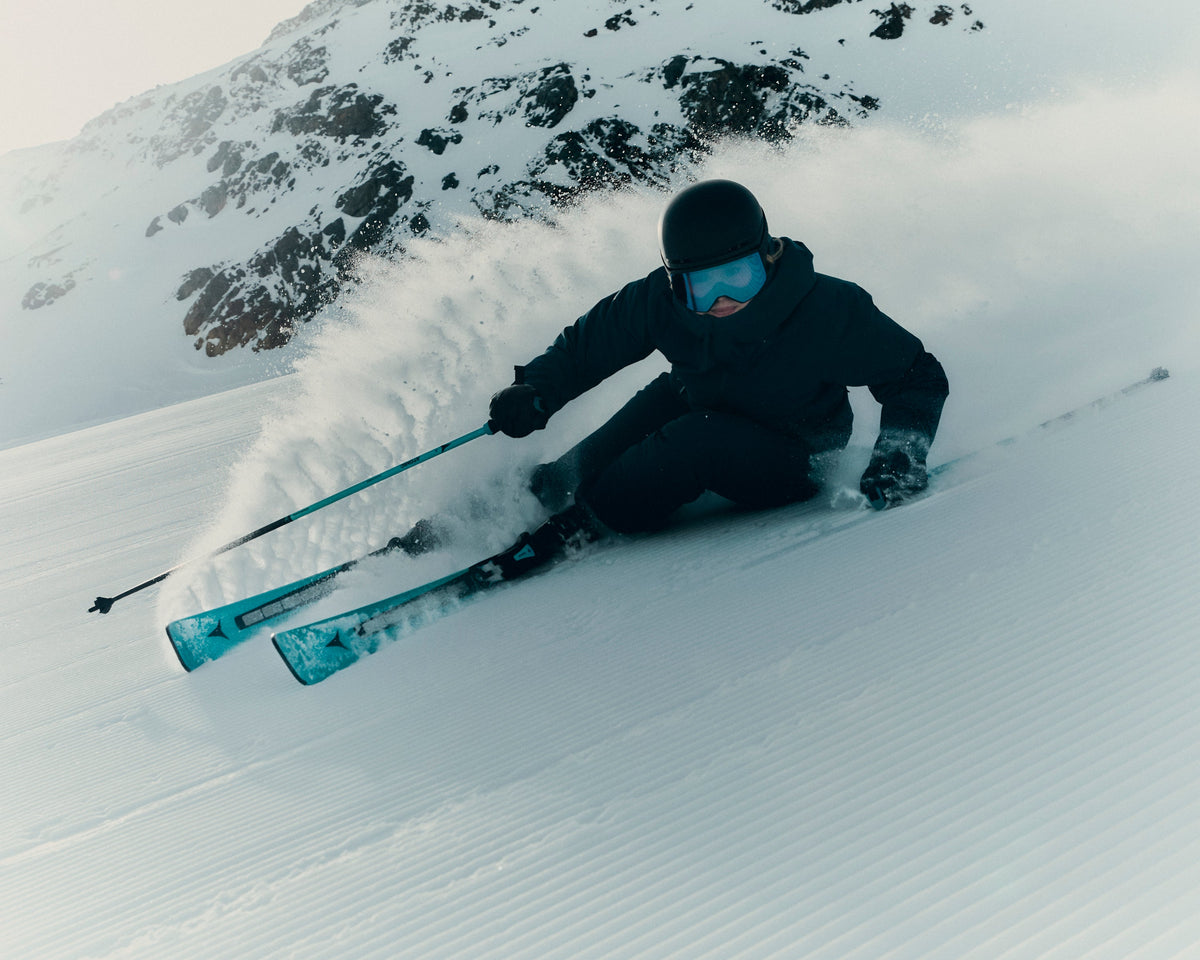
Edges that no longer grip. Skis that don't glide as well. Often the snow isn't the problem – maintenance is. A dry base, dull edges or boots that never fully dry can affect performance all season long. It doesn't always take a trip to the workshop: waxing at the right intervals, checking the edges and drying and storing your equipment properly will keep it in top shape for longer.An Atomic ski technician explains what matters when it comes to waxing, edge care and the proper storage of skis and ski boots.
An Atomic ski technician explains what matters when it comes to waxing, edge care and the proper storage of skis and ski boots.
It depends on how often you ski. The base is a good indicator: when it turns grey, it's time for fresh wax. If you ski every day, waxing every two to three days is enough. Waxing daily is not necessary. You can use hot wax applied with a wax iron, or one of the liquid waxes available today.
What happens if you ski without wax?
Performance changes noticeably. Turn initiation becomes less precise, edge grip decreases and glide drops. You notice it most on flat sections, where the ski no longer glides efficiently. The construction of the ski is not affected – this is purely a maintenance issue. However, you lose the direct feel and responsiveness that skiers rely on.
Do snow conditions affect how often I need to wax?
Yes, significantly. Autumn conditions with glacier snow and low temperatures are particularly demanding. The colder it is, the sharper the snow crystals and the faster they wear down the base.
Spring snow is also a challenge because it changes throughout the day. The sun softens it and it sticks more to the base. Overnight it refreezes into coarse, granular spring snow. This cycle puts additional strain on the base.
Can you use liquid wax instead of hot wax?
Liquid wax is a good alternative, especially in slalom, where it has also proven itself in the World Cup over the past three to four years. Ultimately, whether it is suitable depends on the construction of the ski. In giant slalom, downhill and super-G, traditional hot waxing with an iron remains the standard.

It shows most clearly on hard snow: the ski slides sideways. You initiate a turn, but the edge doesn't bite and gives you no hold. This lack of grip is a sign of dull edges.
What is the fingernail test for ski edges?
You can check edge sharpness quickly with your fingernail. Gently draw your nail across the edge: if it catches or shaves off a fine layer, the edge is sharp. If the nail glides over it without resistance, the edge is dull.
Because repeated tests wear down the fingernail, the fingertip is a better option: it has far more nerve endings and is much more sensitive to edge sharpness than the fingernail, which has no nerve receptors of its own.
How often should edges be professionally sharpened?
For average skiers, the interval depends on the number of ski days – whether you ski 20 days or more than 100 per season. As a general guideline, a machine edge sharpening every two weeks is recommended.
Can you repair damaged or nicked edges yourself?
Minor damage can be fixed at home. It is often a case of hardened spots on the edge. Wrap sandpaper of 60 or 80 grit two to three times around a flat file and use it to work on the hardened spot.
A file alone won't get you anywhere here, because it glides over the hardened spot without removing material. The surface first has to be roughened and broken up so that it can then be worked and reshaped.
Larger damage requires machine repair, usually with several passes over an abrasive belt. Most damage can be repaired. Only in extreme cases is an edge beyond saving.
The simplest way is to fasten the skis together at the bindings with a ski strap and let them drip dry. Then wipe them down with a cloth to remove snow and moisture from the edges. This step alone significantly reduces the risk of rust. Dry storage is also crucial, because damp rooms are the biggest risk.
Why is it important to dry skis? Can't you just leave them wet?
The snow that remains on the ski is the main problem. Many ski resorts spread salt on the slopes, especially in spring. When salt comes into contact with metal, it can cause rust. That is the biggest risk.
Can you store skis in a ski bag in the car?
Yes, as long as the skis are dry. That is crucial. If they are wet and sealed in a bag, the moisture stays trapped and the problem gets worse. The skis warm up and cool down again while the moisture cannot escape. This is exactly what encourages rust.
Transporting skis on the car roof, although widespread, also exposes them constantly to road salt. It is better to carry them inside the car or in a roof box. Salt can attack not only the edges but also the bindings: the steel spring inside can corrode and, in the worst case, fail.
Where is the best place to store skis overnight?
Normal indoor conditions are perfectly adequate at home. Freshly waxed race skis should not be stored outside in sub-zero temperatures. Normal room temperature is ideal.


Close all buckles on the loosest setting. Make sure the liners are completely dry before putting them back into the shells. Keep the boots out of direct sunlight and store them at room temperature in a place protected from light.
The biggest risks to their lifespan are UV radiation, heat and cold. Fully tightened buckles can also be a problem, as they deform the plastic shell over time.
Should ski boots be buckled or open when stored? And does that also apply between seasons?
The buckles should be fastened on the loosest setting so the boot keeps its shape. This applies all year round, including summer storage. If the shell is left completely open, it can spread and lose its tension.
How do you dry ski boots properly after skiing?
Take out the liners and keep the shells out of direct sunlight – so not on a sunny, hot balcony. Drying the liners is especially important. Do not put them on a hot radiator. Underfloor heating or a dedicated boot dryer is a better choice.
The insoles should also be removed, since prolonged exposure to heat can deform them.
How long do ski boots last with good care?
It depends on how intensively they are used. A keen skier who spends 60 to 70 days per season on snow must expect a measurable loss of stability and responsiveness in the shell. It is comparable to a plastic bottle that is permanently deformed by repeated bending.
At the end of the season, the Atomic Pro Center offers a ski storage service for customers. It includes a thorough base grind, edge work, waxing and an infrared treatment.
It is especially important to expose the edges and clean them thoroughly – on both the base side and the side walls. A common mistake: the ski is waxed with an iron, but the edges aren't cleaned sufficiently first.
When heated with the iron, the wood core warms up too. As it cools, a thin layer of moisture can form between the edge and the wax. If the ski is stored like this all summer, rust can develop underneath.
Do you need a special wax for summer storage?
No, a special "storage wax" is not necessary. A standard paraffin wax from any brand, such as Swix, Holmenkol or Start, is enough. Fluorinated wax is not needed. A high-quality paraffin wax with a suitable viscosity is recommended so that it can be applied evenly.
Over the summer, the wax is gradually absorbed into the base. That makes this method particularly effective for storage.
Should you adjust the binding setting before summer storage?
It's not strictly necessary. However, it is advisable to reduce the DIN value slightly to relieve spring tension. The claim that skis must be stored separately because of binding tension is unfounded.
What are the ideal conditions for summer storage?
Low humidity is what matters. A dry room is therefore better than a damp, musty cellar.
A boiler room can also be suitable. Caution is needed, however, if the temperature is permanently above 35–40 °C: with sustained heat, the base can absorb all of the wax. It is therefore worth checking after one to two months whether there is still wax on the base, so that the base doesn't dry out completely by autumn.
Do new skis need to be waxed before the first run?
Not for regular skis. New skis are already waxed at the factory and ready to use. For race skis, it makes sense to apply wax once or twice before the first day on snow.
Can you wax skis with a regular clothes iron?
No, an ordinary household iron is not suitable. Wax manufacturers offer special wax irons, including digital models with precise temperature control.
When waxing the base of children's skis, the temperature should be 120 °C at most. For longer skis from 180 cm, up to 130 °C is possible.
Use enough wax so the base doesn't burn. Apply two lines of wax along the edges so that the iron always glides evenly – as if on rails. The iron should always glide on a film of wax and never touch the base directly.
If there is too little wax, the iron comes into direct contact with the base. Once or twice is usually harmless, but repeated direct contact can damage and burn the base.
How do you know when a ski can no longer be repaired and needs replacing?
There are some types of damage that can no longer be repaired. If the ski is heavily compressed and the laminate has cracked, it can't be restored to its original shape.
A broken ski or a detached side wall that has let water in also usually cannot be repaired. Many skis have a wood core. If water gets in and the wood swells, the damage can't be undone. The same applies to edges with damage too deep to be ground out.
Most damage can be repaired. But these are the limits.
Is it worth doing your own ski service, or should you go to a workshop?
With the right equipment, most skiers can do basic maintenance themselves. This includes a workbench, sufficient light, ski vises and suitable care products.
Liquid wax is particularly easy to apply: apply it, let it work for 30 minutes and then scrape it off. No workshop visit is needed for that.
However, when it comes to restoring the base structure or preparing the edges from scratch, the know-how of a specialist retailer is required.